
What Is EMDR Therapy, What Does It Help, and What Should You Actually Expect?
If you’ve spent any time researching trauma, anxiety, or therapy online lately, you’ve almost certainly stumbled across four letters: EMDR. You’ve probably also heard people describe it as everything from "life-changing" to "that weird therapy where you move your eyes back and forth while thinking about bad stuff."
As a therapist, I like plain, straight talk. So let’s strip away the clinical jargon and break down what EMDR actually is, what it helps with, and what happens when you sit down for a session—minus any mystical hand-waving.
1. What Exactly Is EMDR? (No, It’s Not Hypnosis)
EMDR stands for Eye Movement Desensitization and Reprocessing. (I know, it’s a mouthful. Try saying that three times fast.)
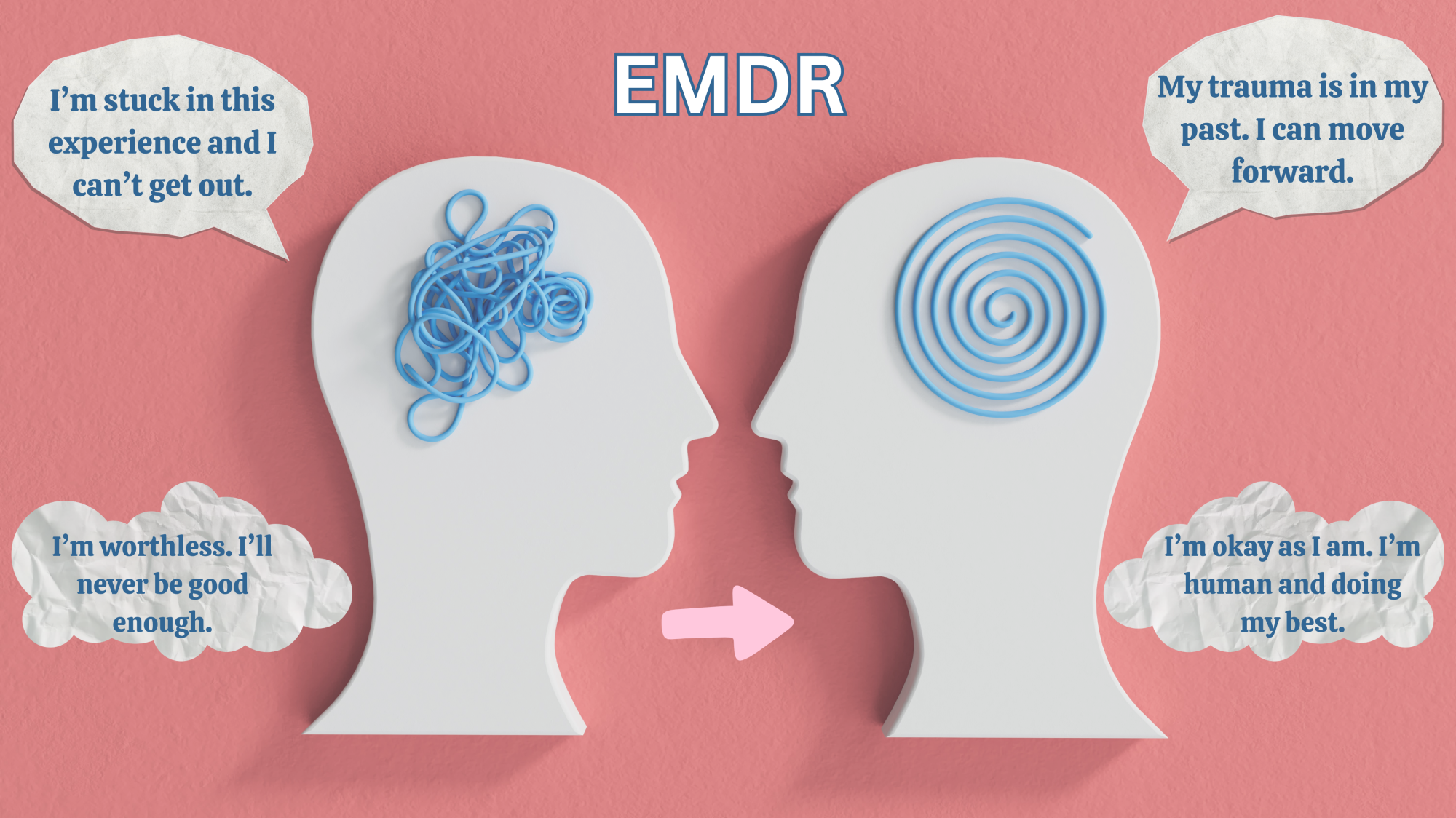
At its core, EMDR is an evidence-based psychotherapy designed to help your brain process stuck memories. When something distressing or traumatic happens, your brain’s natural filing system can get overwhelmed. Instead of filing that memory away in the "past history" folder where it belongs, your brain leaves it right on your desk—active, noisy, and constantly triggering your body's stress alarms as if it's happening right now.
Think of EMDR like clearing a paper jam in your brain's internal copier. The information is all there, but until we unjam the rollers, every attempt to move forward prints out another mess of anxiety.
EMDR uses what clinicians call Bilateral Stimulation (BLS)—usually standard left-to-right eye movements, alternating taps, or auditory tones. This bilateral movement activates both hemispheres of your brain, similar to what happens naturally during REM (Rapid Eye Movement) sleep. It gives your brain the biological momentum it needs to digest those stuck experiences and file them away permanently.
And to clear up a common misconception: No, you will not be hypnotized. You are fully awake, totally in control, and grounded in the room the entire time.
2. What Does EMDR Help With?
While EMDR became famous for treating Post-Traumatic Stress Disorder (PTSD) in military veterans and first responders, decades of research have proven it helps with a wide range of issues. You don't need a single catastrophic event to benefit from EMDR.
EMDR is highly effective for:
PTSD & Single-Event Trauma: Car accidents, combat experiences, assaults, medical trauma, or sudden losses.
Relational & Complex Trauma: Growing up in an unpredictable environment, emotional neglect, or long-term stressful relationships.
Anxiety & Panic Attacks: When your nervous system feels perpetually stuck in "fight, flight, or freeze."
Negative Core Beliefs: Deeply embedded internal scripts like "I'm not safe," "I'm a failure," "I'm helpless," or "It was all my fault."
Performance Anxiety & Phobias: Overcoming intense fears that keep you stuck in your personal or professional life.
3. What to Expect During EMDR Sessions
One of the biggest benefits of EMDR is that you do not have to recount every single horrific detail of your life out loud for 50 minutes. If talking through trauma was all it took, most people would have healed years ago. EMDR works on the neurobiological level.
Here is what the process actually looks like step-by-step:
Phase 1 & 2: Getting Grounded & Mapping Out the Plan
We don't dive straight into the deep end on day one. First, we get to know your story and build practical coping tools. You’ll learn mental "resourcing" techniques so that if uncomfortable emotions arise, you have a solid brake pedal to bring your stress levels back down.
Phase 3 to 6: Target Processing
Once you’re ready, we select a specific memory or target to work on. I’ll ask you to bring that memory to mind, along with the negative belief associated with it (e.g., "I am unsafe") and the physical feeling in your body. Then, we start sets of bilateral stimulation (following lights/fingers or using alternating tappers).
Between short sets, I'll ask a simple question: "What comes up now?" You might notice thoughts shifting, physical tension releasing, or new insights surfacing. We let your brain do the heavy lifting while I serve as your navigator.
Phase 7 & 8: Closure & Check-In
We always leave time to bring you back to a state of calm before you walk out the door. In subsequent sessions, we evaluate how you felt during the week and ensure the distress attached to that memory remains down at a zero.
Will you forget what happened? No, EMDR isn’t a Men in Black memory eraser. You’ll still remember the event, but it will feel like watching a boring rerun on TV rather than being thrown back into the fire.
Ready to Stop Carrying Old Weight?
Therapy doesn't have to mean sitting on a couch talking in circles forever. If you’re tired of old memories running your present day, EMDR offers a direct, structured path toward real relief.
Coming This October: EMDR at Pirtle Counseling LLC
Whether you’re dealing with trauma, chronic anxiety, or just feeling stuck in old patterns, you don't have to figure it out alone. Pirtle Counseling LLC provides straightforward, effective therapy tailored to your life in Kingfisher, Oklahoma, and online statewide.
EMDR therapy will be officially launching as a new service at Pirtle Counseling this October.
Spots for processing blocks and specialized EMDR sessions will be limited. Reach out today to get started with therapy or request to be added to the EMDR Waitlist so you can secure your spot as soon as it becomes available.
Schedule Your Consultation Today
Talk soon,
Dustin Pirtle, MSW, LCSW
Pirtle Counseling LLC | Kingfisher, OK
Simple, direct, evidence-based care.
